
The Clay Pipe
The Clay Pipe making trade in C17th Amesbury 'Gauntlet Pipes'
"The best for shape and colour (as curiously sized) are made at Amesbury in this country. They may be called Chimneys portable in pockets."
(Histories of the Worthies of England, published posthumously in 1662, Thomas Fuller (1608-1661), English churchman and historian.)

Tobacco smoking gradually became popular in the UK when it was brought across from Virginia, America by Sir Walter Raleigh in 1586.
At that time, tobacco was seen as being good for your health whereas potatoes were viewed with suspicion!
By the time of the Great Plague of London in 1666, tobacco smoke was widely recommended as a defence against 'bad air' which was thought to be the cause of the Plague and other illnesses.
Pipe smoking became popular among men, women and children and was called 'tobacco drinking'.
The Gauntlett family of Amesbury were one of the earliest C17th pipe makers establishing a reputation for a high quality product. Their pipes were embossed with the Gauntlett stamp, which was a distinctive tear drop shape.
Who used the Gauntlett Clay Pipes?
Gauntlett stamped pipes have been found in London dating from around 1600 onwards. Excavations in Exeter found a group of Gauntlett pipes from about 1610-30, likely to have come from a shop.

1st Marquis of Hertford

Duke of Bedford
Records show that the aristocracy favoured the Gauntlett pipe. The first Marquis of Hertford purchased pipes from Gauntlett in 1641. The Duke of Bedford also purchased pipes in 1651 from Hugh Gauntlett, himself, at The Swan Inn, which is now the site of The Bell.
The Gauntlett clay pipe's popularity with the aristocracy is further evidenced by their recovery from places such as the Jewel Tower in Westminster and the palace sites of Oatlands and Nonsuch in Surrey.
How much did the Gauntlett Clay Pipes cost?
Records show that The Marquis of Hertford purchased his Gauntlett pipes at a cost of 1 shilling and 11 pence for a dozen (12), that would be 10p in decimal currency. Today they would cost about £21.34 for 12.
This was the equivalent of a day's wages for a skilled tradesman in 1640. It's likely that such a tradesman was buying his claypipes for 2 or 3 pence a dozen, approximately £2.13 today for 12.
Where were the Clay Pipes made?
A clay pipe factory owned by the Gauntlett family from around 1600 - 1698 was situated at Wrestler's Gate outside the Priory Manor between Normanton and West Amesbury.
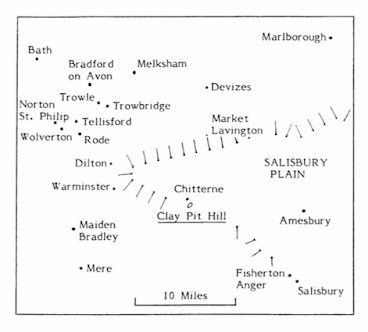
By 1651, the Gauntlett families of Amesbury were producing their high quality pipes using a claypit in Chitterne. That claypit was also supplying manufacturers all over the country at the time.
Another extraction site at Clay Pit was on Lord Henry Paulet's land. It was from here that the middle men Edward Fripp and Christopher Merewether were granted exclusive rights to extract the clay. Fripp and Merewether then carted the clay to the Gauntlett family in Amesbury for manufacture into pipes. In return they paid Lord Paulet £10 (£2,134 today) and gave him 1,152 pipes to be delivered to him at The Angel in Andover.
Map to show the position of Clay Pit Hill and the surrounding pipemaking towns and villages of Wiltshire and East Somerset.
There are no references to members of the Gauntlett family making pipes after 1705, nor does the heel stamp occur on pipes after this date.
- Need to Know -
Smoking tobacco was seen to be good for your health when it was first introduced.
The 'Gauntlett' brand pipes gained a reputation of being among the best quality in the country. Amesbury, together with Marlborough, became centres of clay pipe making in Wiltshire, supplying manufacturers all over the country.