
1646 - 1730
Amesbury Curate, Vicar & Inventor
Thomas Holland
Setting the Scene
In Lucy Worsley's programme on The First Georges, in particular the episode on George I, she walked around some gardens explaining that George was buried near there. In the background was a fountain which has an Amesbury Link.
George, Elector (Ruler) of Hanover, inherited the British throne in 1714, and from then he mainly lived in Great Britain but frequently returned to Hanover, spending time at Herrenhausen, his summer residence.
Together with his mother Sophia, they doubled the area of the garden and intended to install a fountain that would be higher than any at Louis XIV's palace at Versailles.
Officially opened in 1720 the Great Fountain of Herrenhausen was the highest fountain in the world, attracting the attention of travellers and visitors for three hundred years.
For half that time it was powered by a pump invented by Thomas Holland, the Curate of Amesbury.

The Great Fountain in a coloured engraving of 1800, the garden bustling with onlookers.
Early Years
Thomas Holland was born in 1646 at Great Durnford, in the Woodford Valley and was baptised there on 10 July 1647 by his grandfather Edward Holland, then vicar of Durnford. His father, also Thomas Holland, became vicar of Amesbury in 1660.
Thomas attended Oxford University, and then took Holy Orders.
Following his Curacy (when he presumably lived at the Curate's House) he succeeded his father as Vicar of Amesbury in 1680.
Father and son both presided over a period of non-enthusiasm for religion.
in 1662 'the church, chancel and some seats needed repair' and many of the congregation 'absented themselves from sermons, refused to have their children baptised, refused to receive the communion, refused to attend church and give thanks to God for their safe deliverance and refused to pay their duty for Easter offerings to their minister'.
Besides this apathy the established church had to contend with dissent, especially before the Toleration Act of 1689.

The Church of St Mary + St Melor, Amesbury
Inventor
It is not certain when Thomas began inventing, but he made his name as an inventor of hydraulic engines and pumps,
He also invented an 'apparatus for extinguishing fires', which in 1771 may have been housed in a building in Tanners Lane (Flower Lane) described as the 'Engine House'. In the 19th Century the engine was stored in the North Transept of the Parish Church.
It was, however, his water engine that aroused the most interest and controversy, the creation of which could only have resulted from several years of development.
The most likely place for the development was on the River Avon, adjacent to the Vicarage and Amesbury Manor House.
He may have used the mill located on the river as water engines at both Herrenhausen and Shaftesbury are recorded as being reliant on a natural water source to create sufficient force to power the engine.

Amesbury 1726
The Invention/ Science
Holland's engine (1716 Patent 410) transformed the rotational power of the wheel into pressurising water along pipes to give a continuous flow.
This was done by 'curiously contrived' locks and collars and forcers, or pumps, with valves to direct the water flow into pipes.
This pump seems to have been designed to raise water 70 ft to the house and/ or 80 ft to Lord Tylney's gardens at Wanstead House. Rotating at 5 rpm, it supplied 95 hogsheads (hhd) per hour to the house and, at 3 rpm, 47 hhd to the gardens.
1 Hogshead = 54 gallons or 6 firkins
In 1744 the Rev Dr John Theophilus Desaguliers (who we would now call a scientist) describes the pump and its action in his Course of Experimental Philosophy as being
' 30 ft in diameter and the main shaft 24 ft long and 24 inches in diameter. The ingenious rings or collars were 3 ft in diameter and the pumps were 7 ft long with a diameter of 6 inches. The principal construction was in wood, with metal triggers and locks for the collars, similarly for the pumps chains and pipework. the waterwheel was undershot, with a fall of 7 ft'.

Mr Holland's engine for driving a pump to drive directly the jet fountains at Wansted showing the use of chains and especially spaced metal teeth on the pulleys G, F, E and D to ensure that the pistons act to produce a continuous flow.
Patents
Thomas Holland took out two patents, one dated 17 October 1691 and the second dated 28 November 1716.
The 1691 patent was for 'an engine or machine which will be of singular use and benefit to the publick for the raising, drawing up, forcing, and discharging of water in very great quantities in short time out of any drowned mines, pitts, coale delphs, and groves, with their sucks and shafts, and any other place whatsoever, as also for all manner of draines, and the supplying pipes and conduits with water in cities and towns, and laying under water dry grounds whereunto rivers are adjoining with far lesse charge and labour then what hath been necessarily required in the ways hitherto used and practised, the same being also applicable to several other uses, aswell at sea as on land'.
It is possible that one of these 'engines' was used in the Radstock, Somerset area, where coal was mined. Further research is ongoing by Jamie Wright.
The 1716 patent was for 'a new machine or engine for raising a continuall flux of water with two barrells, only in much greater quantity, with more ease and certainty, by locks an chain works than by any engine hitherto invented'.
Interestingly this patent was taken out after installing the engine in Shaftesbury, at the end of the installation of an engine at Dawley House, Middlesex.
Dawley House, Middlesex
In 1695 Charles, 2nd Baron Ossulstone inherited Dawley House, Middlesex from his father and improvements were under discussion in December 1707, when he recorded that 'Mr Holland came from Amesbury about ye engion'.
A year later 'We made an end this evening with (?) ye pipes wch brings ye water from ye upper end of ye Long Walk' and in December 1709 'The men were diging of ye well for Mr Holland's engine';... The workmen are very busie about ye well and engion house'; and ... 'Gave Mr Holland 5G: £5.7.6 as a gift for being here and assisting about ye engion.'
Thomas Holland visited Dawley between 23 August and 10 September 1710, and again on 23 September 'Mr Holland .... who is here setting up an engion'.
Further work took place in 1718 (payment of £24 in full of wooden pipes and all manner or workmanship about the engine at Dawley) and in March 1719 a bill for £90 for the 'New Water Engine' at Dawley was settled, partly by an allowance of £30 for the materials of the old water engine.
Wilton House
Charles II fuelled a growth of interest in science and the arts.
The growth of interest in Natural Philosophy (an obsolete term for science) motivated the development of an international trend of competition in the creation of the biggest and highest propelled fountains.
This created a need for some means of propelling water vertically to previously unattainable heights.
Holland's pump relied on an ingenious mechanism which meant water could directly supply the fountain and an intermediary reservoir was not needed.
Holland installed pumps to supply fountains, driven by undershot water wheels, at Wilton House, Wiltshire, and at Wanstead House, Essex and Dawley House, Middlesex.
The 'Villain'
William Benson was the son of a wealthy iron merchant from London (who had been Sheriff of London 1706-7 and knighted in 1706).
William had completed the Grand Tour as a young man, and a prolonged visit to Hanover, the seat of the Elector, who was next in line to the British throne.
In 1708, he took a long lease on Amesbury Abbey, 'subject to changes to the house', but then cut short the lease and in 1709 moved to Newton Toney.
William bought the Old Manor House, which he rebuilt and re-named it as Wilbury House.
In 1709 William was appointed High Sheriff of Wiltshire.
It was during 1708-1709 that it was most likely that Benson and Holland initially crossed paths, as it seems probable that Thomas' water engine experimentations were closely located to, and visible to, the inhabitants of the Amesbury Abbey.
In 1714 Benson had the ambition to become an MP at Shaftesbury, and 'persuaded Mr Holland the curate of the town of Amesbury to build his own water engine'.
Consequently, Thomas built a working version of the engine at Wincombe Park on land owned by Benson outside the town.
In 1715 'in an attempt to bribe the electors of that town' Benson had, by using Holland's water engine, successfully 'controlled the water supply to the town, as motivation for his elevation to MP.'
William Benson was the MP for Shaftesbury between 1715 - 19.

Wilbury House
Building Faults
Benson had already demonstrated Shaftesbury's water supply to King George, claiming his own ability to build a suitable water engine to power the fountain at Herrenhausen Gardens in Hanover. This was commissioned in the spring of 1718.
Despite Holland having taken out two patents, Benson simply 'bootlegged' the pump, even passing it off as his own invention.
Taking Joseph Andrews (a mechanic), John Cleeve (a master carpenter) and nine other English craftsmen Benson started work in spring 1718. By using English craftsmen Benson believed he had the knowledge to build the water engine. Two translators were provided, and they were allowed to brew their own beer (the Hanoverian drinks not being to their taste!).
At the first trial, in front of the King and his court, the new fountain only reached 10 feet in height, rather than the anticipated 100 feet.
Benson and Cleeve failed to find any fault, suggesting that to rectify it the engine might have to be run off a reservoir. John Helot - another builder - had independently reviewed the issues with the fountain and identified a fault in the building of the engine resulting from a fault in a 90 degree angle which should not have been there.
Helot advised Benson and Cleeve to remove it, but subsequently the builders claimed they had resolved the issue through the cleaning of pipes, thus attempting to cover up their mistake.
John Helot then enlightened all the interested parties of the pertinent facts.
.jpg)
King George 1
1714
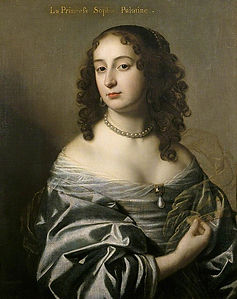
Sophia, mother of King George 1, who was instrumental in planning the new gardens at Herrenhausen
_-_Electress_Sophia_(1630%E2%80%931714)%2C_Princess_Palatine%2C.jpg)
Benson's Downfall
Benson was awarded with 'the reversion of Auditor of the Imprest' (auditing the accounts of officers of the English crown to whom monies were issued for government expenditure - a faulty system abolished in 1785).
He was then appointed to the post of Surveyorship of Works - he was infamous for his corrupt, incompetent and consequently brief tenure as the surveyor-general which ended in dismissal for deception of the King and government.
As Surveyor, Benson's months in office proved disastrous for the professional staff. Howard Colvin noted that "Benson's surveyorship lasted for fifteen months, in the course of which he sacked his ablest subordinates, declared war on his closest colleagues, infuriated the Treasury and finally brought down upon himself the wrath of the House of Lords for falsely insisting that their Chamber was in imminent danger of collapse."
The only lasting work produced under Benson's surveyorship was the suite of state rooms, designed by William Kent, at Kensington Palace.
Benson stood for Parliament again at Shaftesbury at the 1727 general election. However, he only received four votes and thereupon cut off the water supply to Shaftesbury town.
Rev Dr John Desaguliers (1683 - 1744), a lecturer in Experimental Philosophy (a now obsolete term for science) in London, made several mentions of Thomas Holland relating to his invention of a water engine and gives the belated credit back to Thomas after Benson had previously claimed the credit and financial rewards.
Holland's Honour
Desaguliers researched two existing engines of Thomas Holland's design - the first at Wilton belonging to the Earl of Pembroke, the second at the Wanstead home of Lord Tylney (or Tinley) - there being a large gap between the erection of each.
The research had involved a fellow scholar of Natural Philosophy, Mr Beignton, who concluded that Holland's approach to the water engines had pointed to some 'faults' in the design of the engines.
Desaguliers responded 'that notwithstanding the faults I have found with Mr Holland's engine, they have their merits', stating that 'although some things were not performed according to the strict rules of the art' (Experimental Philosophy), 'which the owner of the engine is not supposed to understand', he considered those 'faults' as given to him, no to be faults so much as the creator (Holland) not having the benefit of such knowledge or education.
He further states that 'Mr Holland, being modest to a fault, was often cheated of the profits as well as the honour of his invention, for he was certainly the first who contrived to make a jet without a reservoir'.
It seems that Thomas Holland gained little praise in Hanover where he is still described as Benson's employee, if mentioned at all. Thomas Holland died on 11 May 1730, and was buried in Amesbury on 13 May.
The Grand Fountain at Herrenhausen continues to work, albeit with an electric pump since 1956.